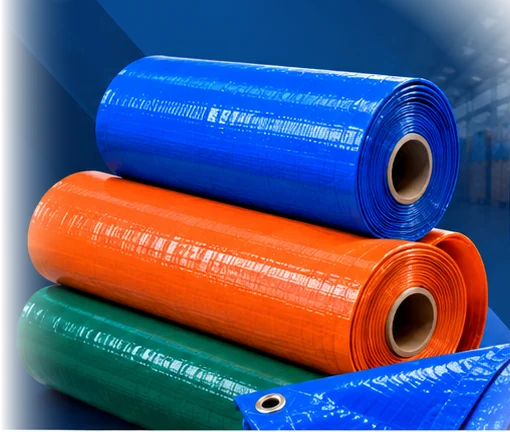
Transparent tarpaulin is bought for one reason the opaque grades cannot serve: you need the cover on and you still need to see through it, or you need daylight to reach whatever is underneath. A clear sheet does both, and that changes what it is used for.
Where a clear sheet is the right answer
- Shop fronts and stall sides. Rain and wind stay out, the display stays visible and the shop stays lit. An opaque cover closes the shop; a transparent one does not.
- Balcony, verandah and terrace enclosures. The space stays usable through the monsoon without turning into a dark box.
- Restaurant and cafe seating. Outdoor covers that keep the weather off without losing the view or the daylight.
- Nursery and greenhouse cover. Light has to reach the plants, so a clear sheet is the only workable choice.
- Machinery and stock that must stay visible. Anything you need to inspect or count without untying the cover.
Transparent, clear and translucent
Buyers use the three words interchangeably and they are not quite the same thing. A fully transparent sheet lets you see through it clearly. A translucent one passes light but diffuses it, so you get brightness without a clear view. Which one suits depends on whether you are covering a shop front, where you want to be seen into, or a storage area, where light is all you need.
| Sheet | See through it | Light passes | Typical use |
|---|---|---|---|
| Transparent | Yes, clearly | Yes | Shop fronts, balcony and seating enclosures, anywhere the view matters |
| Translucent | No, diffused only | Yes | Nurseries, covered storage and work areas that need daylight but not a view |
| Opaque (HDPE) | No | No | General covering, transport and site cover where light is irrelevant |
Tell us which of the two matters on your job and we will supply the right sheet. It is a common mix-up and it is worth settling before the order rather than after.
How a transparent sheet differs from our HDPE range
Our standard tarpaulin sheets and plastic tirpal are woven polyethylene, laminated to close the weave. The weave is what makes them strong, and it is also why they cannot be clear.
Transparent tarpaulin is a different construction: a PVC sheet rather than a woven and laminated one. It is fully waterproof in the same way, but it behaves differently in the hand and is priced on a different basis, so it is not a like-for-like swap on rate against a polyethylene sheet of the same size.
Where a clear sheet needs the strength of a woven cover, it is usually supplied with a reinforcement grid or with reinforced borders and eyelets at the tie points. Tell us the span and how it will be fixed and we will specify it that way.
What to check before ordering
- Thickness. The heavier the sheet, the better it holds shape in wind, and the less easily it creases and clouds at the folds.
- Fixing. A clear sheet used as an enclosure is usually fixed along its edges rather than thrown over a load, so the hem and eyelet spacing matter more than on a covering sheet.
- Sun exposure. Clear sheeting in constant direct sun will yellow over time. If the run is in full sun all day, say so and we will advise on the grade.
- Finished size. As with every sheet we make, hemming consumes material from the edge — see cut size versus finished size.
Sizes and rates
Transparent and clear tarpaulin is cut to order in any width and length, with hemmed edges and eyelets at the spacing your fixing needs. It is made and dispatched from our Delhi facility across India.
Because the construction is different from our polyethylene range, the rate is worked out separately — send us the covered area, the thickness or the job, and the quantity. How tarpaulin price is calculated explains the factors that apply across everything we make.